My blog assignment for this month was a very general one, to write about something that may interest young people during their stay in Hawaii. We have been getting more and more high school students and college students coming to Hawaii each year to participate in the
Honolulu Festival. And these students come from both the east and the west, mainly from Japan and the U.S. mainland. (Please read about Richard Tagawa and
Hawaii Music Festivals at the very end of this article.)
This assignment is not as easy as it may seem because both my children are in their twenties therefore I am clueless as to what would interest high school and college students. Besides, I prefer writing human interest stories rather than an article about “things to do in Hawaii.” So my goal is to accomplish both.
I picked up this magazine at the airport called “
101 Things to Do.” It is a complimentary magazine that is published every six months. The magazine literally talks about 101 things that visitors and even kama’aina can do in Oahu. Looking through the magazine I came to the conclusion that young people, no matter where they come from, want to experience Hawaii’s beautiful beaches. And on Oahu, a surfing experience in Waikiki is a must. But it’s not just about taking a surfing lesson on Waikiki Beach. It’s about interacting with the knowledgeable “Waikiki beach boys” and feeling their “aloha.” I am sure that there are many beach service companies in Waikiki that offer wonderful programs for our visitors. Let me introduce the pioneer of these companies,
Aloha Beach Services. This reputable company has been in business in front of the Westin Moana Surfrider for over 50 years catering to the needs of our visitors.

 The view of Diamond Head and Waikiki Beach in front of Aloha Beach Services.
 Surfboards are all lined up, ready for rental. Nice Hawaiian grass shack reminiscent of old Waikiki.
That’s right, Aloha Beach Services, run by Didi Robello and his staff, go back many, many years. I will eventually get into the details of the surfing lessons that Aloha Beach Services has to offer. I’ll even talk a bit about how they cater to the Japanese visitor. But before I do, let me “talk story” about how Aloha Beach Services came to be and some interesting stories about the Robello Family.
As many of you may know, Hawaiian history refers to surfing as the Sport of Kings because long ago it was Hawaiian royalty that had access to the best beaches and the best boards. Eventually surfing became popular with the common folk but then was oppressed by the Europeans who came to live in Hawaii in the 1800s. Surfing was considered frivolous and immoral for a period in Hawaiian history. It was a small group of beach boys led by the likes of Duke Kahanamoku who changed all that at the beginning of the 1900s. Duke was the first Hawaiian Olympic champion. Duke was one of the organizers of the original amateur surfing club in 1908, you know, the very famous Outrigger Canoe and Surfboard Club. By this time the first tourist resorts were being constructed in Waikiki and these beach boys decided to make their living by teaching tourists how to surf and giving outrigger canoe rides. Pretty soon, surfing with the beach boys became one of Hawaii’s major attractions.
Didi Robello’s grandfather was Bill Kahanamoku, Duke Kahanamoku’s brother. Bill’s daughter, Barbara Kahanamoku, married Didi’s dad Harry ‘Pop’ Robello who was a beach boy in the 1930s. Pop Robello is considered one of the original beach boys. According to Didi, Pop Robello was one of the first ambassadors of aloha and credits him to be a founder of modern tourism in Hawaii. Didi also remembers Pop saying that the original beach boys were in Waikiki before and during World War II. Those beach boys that came after the war when business was booming are not considered original. So Didi is “beach boy royalty,” he is second generation beach boy on his dad’s side and is a third generation Kahanamoku on his mom’s side. Pop Robello started his Moana Hotel concession in 1959 and Didi took it over in 1983. Pop passed away in 2004, bless him.
Didi continues to live up to the standards that Pop believed in. First of all, he tries to keep the area how Pop them had it. Trees and flowers, a very inviting corner right in between the Moana and Outrigger. “He pretty much taught me to be nice to everybody," Didi said. "You can't make everybody happy, but try to make most of them as best as you can. And he said to make sure everything is clean. Keep your beach clean, keep your stand clean, keep your boys clean." This thought hit me when I saw one of his guys cleaning the ashtray in front of Duke’s Restaurant. It’s probably not the responsibility of Aloha Beach Services to do that…but they still do it.

 Didi Robello and young staff
.
Aloha Beach Services staff cleaning cigarette butts.Their business has weathered its ups and downs and is still going strong. I think it is amazing that we have living history right in Waikiki and that visitors and kama’aina alike can rub shoulders with those that carry on the beach boy tradition. To me that is something very special. Most of the original beach boys have passed but the tradition lives on. I had a chance to talk to Blue Makua who works for Didi. He is considered one of the original beach boys (he was the youngest of them and his dad was part of the group too). He has so many stories to share about Waikiki long ago. Blue continues to make the visitors happy and also makes sure that the crew has fun working.

 Blue Makua keeping the area clean.Aloha Beach Services staff by their outrigger canoe.
Our son Ryan grew up living at the Sheraton Moana Surfrider during his summer vacations in the 1990s and became part of the Aloha Beach Services Ohana. He was so proud to “go to work” each day wearing his uniform, the Aloha Beach Services baseball cap and T-shirt. Ryan was the young gofer. To this day he loves the ocean. Cute, the day I visited Didi, there was a young man helping out. He must be the latest “Ryan.” Things never change! The Robello Family has shared their aloha with us through the years. Billy Robello (Didi’s brother) and his family threw a graduation party for Ryan when he graduated from HPU a few years back. And this year, we asked for Didi’s help, the services of his outrigger canoe, so that we could scatter my aunt’s ashes (my uncle and his friends came from Japan) into the waters of Waikiki. Thank you Robello Family!
 Didi and the youngest staff of ABS.Veteran ABS beach boys.
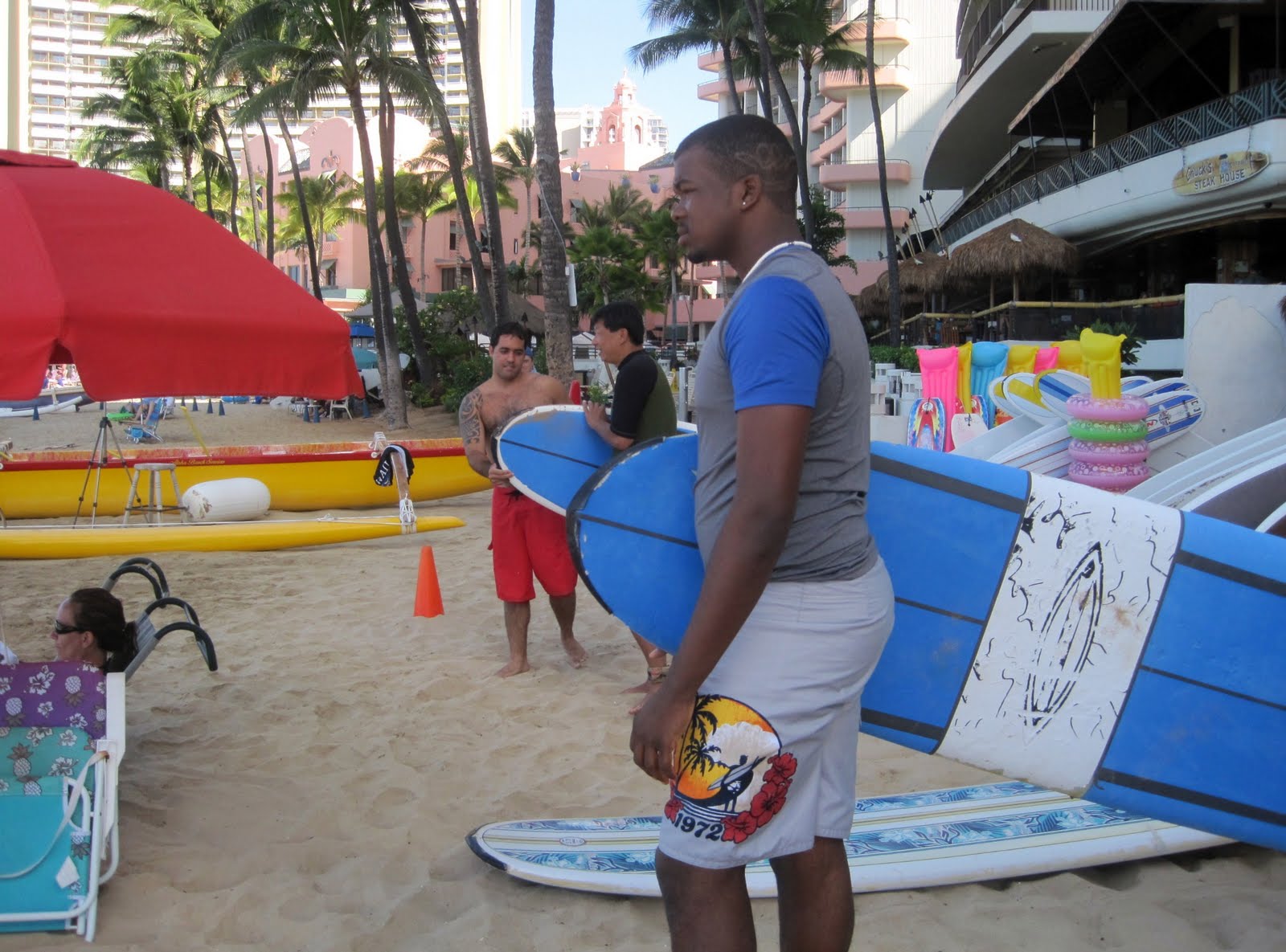
I took the liberty of going down to the concession area and check out how Aloha Beach Services conduct their surfing lessons. The first thing I saw was Malu, the instructor, giving basic lessons with the surfboard planted in the sand. They call this the sand demo. Very important safety information was shared by Malu, e.g. fall flat away from the board, go deep, not shallow. Then there were demonstrations of the basic steps to stand up on the board. There was practice of these steps. I would say that the sand demo took about five-ten minutes. Brief, because many won’t remember everything anyway. And always, the students are anxious to go into the water. They learn how to carry the board into the water. As they enter the shallow area they learn how to turn the board’s direction and how to avoid other surfers. The hour lesson does not include time spent on land. A full hour is spent in the water with the instructor.

 Malu teaching Jordan.


 Last instructions.


Interview with Didi Robello:
Are there any differences between teaching high school/college students how to surf and older customers?
No difference except kids are more gung-ho. Older ones listen better. The kids want to jump on the board and go on their own. Everyone listens carefully to the safety instructions. But when you start doing the sand demo, that’s when the kids go a little wild. They are better if parents are around but if it’s only teenagers....a little wild.
Do you have any recommendations to young people when learning how to surf for the first time?
Safety first. Being young, there is no fear. You need to pay attention. You think you can block the surfboard with your hand. Don’t go after the board. You can always get a new board but teeth are expensive.
What can they look forward to?
They can look forward to being exhausted and hungry, very tired and thirsty.
What is it like teaching students from Japan?
It’s pretty easy because they tend to listen better. English is hard to understand so they pay more attention. They are shy so they’ll just stand in front of our place. They will wait for us to invite them. So we have to ask them to come closer and then they start to talk about surfing lessons.
How do you compensate for the language difference?
All my guys know enough Japanese to get by. The majority of Japanese now know some English. Our boys know key words in Japanese, like how to say “stand up” and “paddle.” If they really have a hard time communicating, Keiko who works in our photography section can interpret. Nobuko who works on the catamaran helps when necessary. We get many Japanese visitors, lots of young couples and kids with their parents.
How much does it cost to learn how to surf?
Rates range from $30 to $80 depending on whether you want group, semi-private or private lessons. Other companies may take longer for the sand demo because they want to attract a larger crowd before going into the water. This time may eat into water time. At Aloha Beach Services we guarantee an hour in the water with your instructor.
Are students able to catch a wave in just one lesson?
Yes. They all stand up. We guarantee we’ll get you up--whatever it takes. Many of the great longtime watermen have died, but it’s a living and proud profession among the next generation. You’ve got to be licensed--it takes a lot of training and experience.
The first lesson doesn’t make them good enough to go on their own the second time. Repetition of lessons is good. The kids need supervision so that they can be taken care of. After the third or fourth time, they pretty much get it.
A lot of people come down to take the lesson. They probably will never do it again so it’s more like an experience. Before the lesson they’ll say that they want to rent a board after the one hour. But after the lesson most of them are exhausted. The next day, sore this and sore that. At least they did it and had fun.
Any final words of wisdom?
Do the beach activities first. You can do the shopping and stuff at night because you never know with the weather. ... The weather might be nice today and real bad tomorrow. Don't wait until your last day to do all this stuff. Do the beach first.
When the waves get big, I shut down the rentals. It’s not worth the danger. Lifeguards love it that we shut down because it makes their jobs easier. If I feel it’s unsafe, I’m not going to rent boards. Guests may grumble but it’s better for everyone.
I notice many tired Japanese visitors sitting in the hotel lobby on their arrival day. They come to the beach on their last day. They should come to the beach first, make them feel better.
Didi Robello shared his knowledge and aloha one morning in front of Aloha Beach Services, on Waikiki Beach, with a dynamic view of Diamond Head right in front of us.
Thanks Didi for the interview.
Aloha Beach Services also offer outrigger canoe rides. What an experience to ride the waves! The guys will take you out and teach you how to paddle.

 Me and my friends on ABS outrigger canoe in January 2010. They are all from Japan but we had no problem taking directions from the crew.
I noticed that several cameras were mounted by their beach service area. Aloha Beach Services offers pictures and CDs of your surfing lessons too. Talk about high tech! I was able to see many digital pictures of the students standing up on their boards and catching waves.

 High tech equipment.That's Jordan standing up!
Incredible! Good teachers make good students!
Aloha.
Honolulu FestivalAloha Beach ServicesHawaii Music Festivals®
organizes student groups to participate in the Honolulu Festival The student groups from the mainland that participate in the Honolulu Festival come through Richard Tagawa of Hawaii Music Festivals®. Richard organized the Hawaii Band and Choral Festivals at the same time as the 16th Honolulu Festival this year so that the students that came could not only perform with their counterparts in the Hawaiian community but also share in promoting cultural exchange with those from the Pacific Rim. Richard’s program also offers workshops conducted by nationally known clinicians. So his programs are very complete covering the educational aspect of music as well as the “fun” part of exploring Hawaii. Some of the “things to do and places to go” that are highlighted on his website include the Arizona Memorial, Polynesian Cultural Center, Wet ‘n’ Wild Hawaii, Diamond Head Hike and Circle Island Tour.
For more information about Hawaii Music Festivals please check out their website.
Hawaii Music Festivals


 Posts
Posts


 Kauai’s rich culture makes it truly timeless. Old Koloa Town is the site of its first sugar mill. Take some time to follow the Koloa Heritage Trail in Old Koloa Town and learn about Kauai’s plantation past. On the North Shore, the Waioli Mission House provides a peek at missionary life in the 19th century. Kauai Museum holds exhibits, artifacts and murals portraying the history of Kauai and its people.