Showing posts with label Hawaiian Grinds. Show all posts

11.25.2010

Funny Hawaiian Fruits

Coconuts and bananas are the most well-known of Hawaii’s traditional staple fruits. But there are many other fruits grown here as well, and some of them are really funny-looking!


Pineapple

Pineapple is well-known the world over, but if you think about it, it’s a strange-looking fruit. One wonders who discovered that it could be eaten? Who was the first to learn that there was a sweet delicious fruit inside that hard, spiky shell? Pineapple contains sugar, malic and citric fruit acids. It is high in vitamin B1, B2, B6, C and manganese. Its enzyme bromelain aids digestion.

Noni

The noni tree has beautiful broad green leaves, and the fruit looks somewhat potato-like, although green, ripening to a translucent yellow/white with warty-looking brown spots. Noni is well-known as a Hawaiian medicinal plant. However, we are warned by gardeners not to plant it near a bedroom window. As it ripens, the fruit smells truly horrible—like unwashed feet that have been in rubber slippers too long. And, it doesn't taste good either! It is known as a famine fruit, which means, probably, edible only if there’s nothing else to eat.

As a medicine, noni juice is used by traditional healers for heart problems, high blood pressure, and diabetes. It’s also used to treat skin cancer.

Star Fruit

Funny-shaped but pretty, star fruit is a really juicy semi-sweet five-edged fruit. When sliced, it looks like a star. It should be eaten when yellow or light green. The edges will be brown, but don’t worry about that. It’s only got about 30 calories and it’s a good source of Vitamin C. It’s also rich in antioxidants, low in sugar and acid.


Breadfruit

Breadfruit is a staple food of Pacific islanders, often substituted for starchy foods like potatoes, pasta, or rice. It can be roasted, baked, fried or boiled; the taste is somewhat potato-like, or similar to fresh-baked bread. The fruit is rarely sold except at roadside fruit stands in season, but a breadfruit tree in your yard is an invitation for locals to come by. A neighbor once took several and a month later brought back some dried breadfruit ‘chips’ to try.
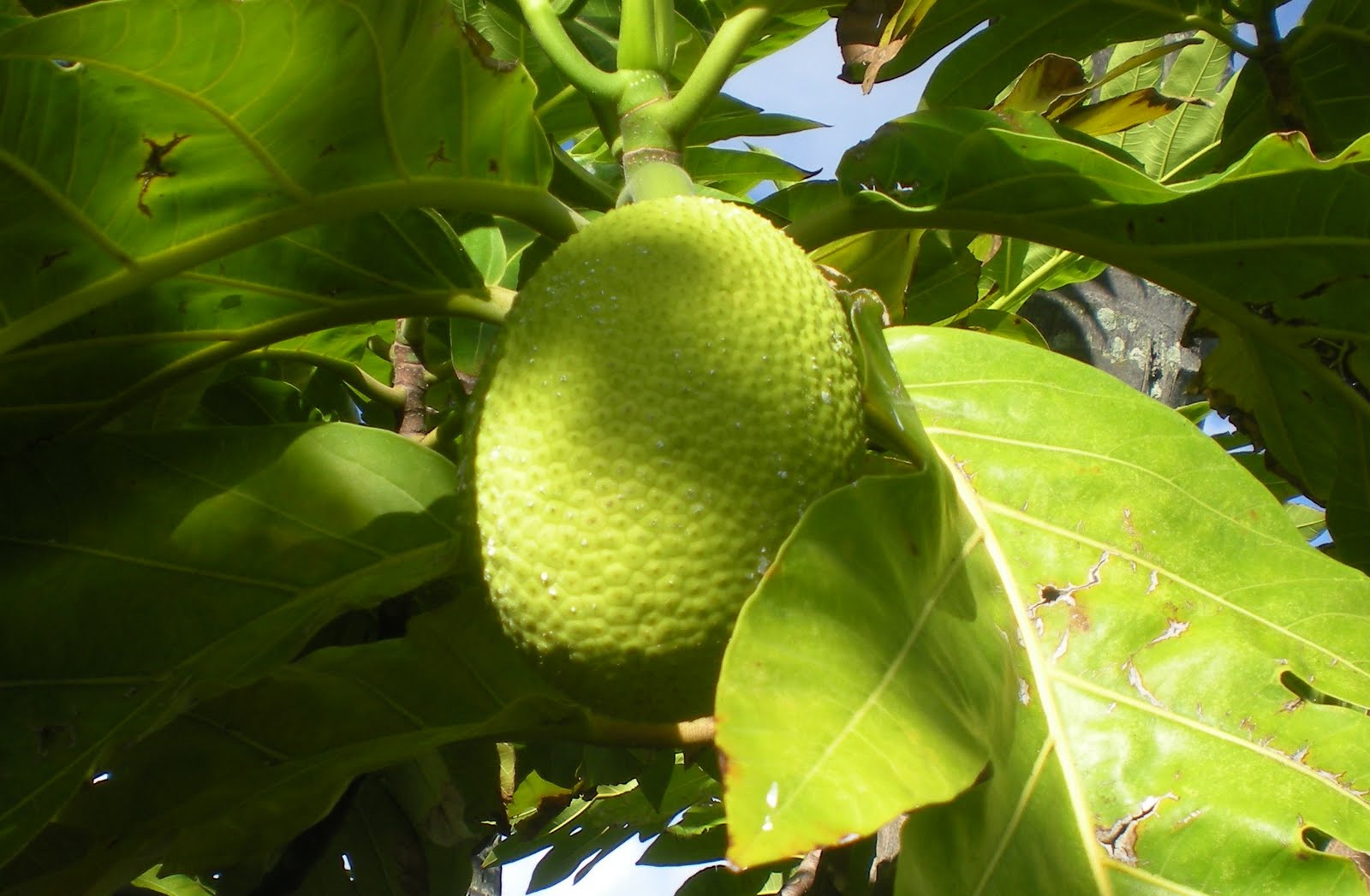
Nutritionally speaking, breadfruit is high in energy from carbohydrates and low in fat. It is a good source of fiber, calcium, copper, iron, magnesium, potassium, thiamine, and niacin.

When cut, a milky juice comes out that’s extremely sticky. In the old days this latex was useful for boat caulking—not sure if that makes it more or less appetizing…

The breadfruit tree leaves, bark, and latex have been used medicinally by native Hawaiians. It’s a whole pharmacy in one tree. The latex can be massaged into the skin to treat broken bones or sprains, and compresses applied to the spine relieve sciatica. Crushed leaves benefit skin problems and fungal diseases like thrush. Diluted juice is taken internally to treat diarrhea, tummy aches, and dysentery. The sap from the crushed leaf stems heals ear infections or sore eyes. Chase away a headache with a remedy made from its bark. It is thought that tea made from the leaves will control diabetes.

Rambutan
"Rambut" is Malay for 'hairy,' so it’s obvious why the fruit is called rambutan. The fruit has a single central inedible seed with white flesh wrapped around it, just like lychee. The fresh fruits are easily bruised and have a limited shelf life. Rambutan fruit is rich in fat, calcium, iron, protein, nitrogen, zinc, magnesium, manganese, potassium, phosphorus, vitamins C and A, thiamin, riboflavin, and fiber. Some sources say that eating rambutan can decrease the chance of cancer, and it’s very effective in lowering blood pressure.


4.21.2010

Great places to eat at the Royal Hawaiian Center


Beautiful gardens and tropical landscape.


Today I’d like to talk about the Royal Hawaiian Center located right in the center of Waikiki. The location known by the Hawaiian people as Helumoa has a very rich history. Hawaiian royalty used this place as their favorite retreat. Of course Waikiki Beach played a huge part in making this area the best vacation spot ever, but also, this particular area had over 10,000 coconut trees creating a beautiful shaded setting. To commemorate these events in Hawaiian history, the Center has created The Royal Grove, a lush garden with a bronze statue of Princess Bernice Pauahi Bishop, great grand-daughter of King Kamehameha, founder of Kamehameha Schools and Bishop Estates, owner of the Center. The Royal Grove is also the setting for Hawaiian entertainment every evening. Complimentary music nightly!

The Royal Hawaiian Center is the perfect place for visitors and kama’aina to shop and dine. There are over 100 shops and dining places, a huge selection from high end to affordable products.

I would like to talk about the places to eat at the Royal Hawaiian Center. What I like about this place is the variety of cuisine that you can choose from. There are all types of food and also, probably very important, inexpensive to expensive dining. So depending on what kind of food you are ono for and also what type of ambience you are looking for…there is a perfect dining place for you at the Royal Hawaiian Center.

First, let me talk about the restaurants. There are eight to choose from. Quite a selection. There are two Chinese places, one that is authentic, Beijing Chinese Seafood, and the other one, a popular mainland chain called P.F. Chang’s. They are both very good and reasonable. Beijing has been there for years and is a favorite of mine. Great dim sum, noodles and all the great dishes that you would expect from a traditional Chinese restaurant. The design of the restaurant is quite nice. I would rate Beijing as the most deluxe Chinese restaurant in Honolulu, along with Mandalay. P.F. Chang’s decor is also nice. Their set menus are wonderful as well as their vegetarian dishes. I have never been disappointed there.


Beijing

P.F. Chang's


There are three Japanese restaurants, two that are on the traditional side, Restaurant Suntory and Okonomiyaki Chibo, and one with the influence of South Beach in Miami. Restaurant Suntory is probably one of the best Japanese restaurants in Hawaii. Their menu includes authentic Japanese dishes, sushi and teppanyaki. The prices are reasonable for lunch. For dinner, I guess it depends on what you order. Simply delicious! Chibo also offers teppanyaki but their main dish is okonomiyaki which is a Japanese style pancake filled with vegetables, meat and seafood. They brush a savory sauce over it (similar to tonkatsu sauce). It is very filling and delicious. Osaka and Hiroshima are well known for their Okonomiyaki. We offered it at the 15th Annual Honolulu Festival and the attendees loved it.


Suntory

Chibo's


As you can see, I am into Japanese cuisine. Sushi Doraku is quite interesting because it is creative fusion cuisine. This place is owned by Kevin Aoki, the son of Rocky Aoki of Benihana fame. His original restaurant is located in Miami’s South Beach and Sushi Doraku has that South Beach flair. The ambience is hip and I have been told the evening crowd is quite lively…exciting food and cocktails.


Sushi Doraku

Tekka Don (ahi and sushi rice)


Representing Mexican food at the Royal Hawaiian Center is Senor Frog’s Honolulu Restaurant and Bar. It’s a fun place for all to hang out, sing and dance. The menu includes many Mexican dishes but also a variety of finger foods, salads, burgers and sandwiches. Very reasonable too.


Senor Frog's


The last two restaurants are The Cheesecake Factory and Wolfgang’s Steakhouse. I think that many of us have craved the cheesecake at the Cheesecake Factory. It is delicious! That place is always crowded. I see folks waiting to get in all the time. And what a beautiful setting at Wolfgang’s Steakhouse. I have noticed that although the menu can be pricey, that they also offer some great deals. So if you are ono for a juicy steak, this is the place to go.


Wolfgang's Steakhouse

Overlooking Kalakaua Avenue


Apart from these restaurants, the Royal Hawaii Center has little shops like Chip and Cookie (Wally Amos is the owner), Honolulu Cookie Company (great gift ideas), Island Vintage Coffee and Starbucks Coffee (gotta have a coffee place), Panya (great breads and desserts) and Tropical Iceland (unique ice cream treats).


Chip and Cookie

Honolulu Cookie Company


Island Vintage Coffee

Starbuck's Coffee


Panya

Eat Panya's goodies outdoors


The last place that I would like to introduce is their Food Court called Pa’ina Lanai on the Second Level. This is the place to go if you’re rushing to grab a bite during your busy shopping at the 100 stores at the Royal Hawaiian Center. Again, variety galore! Ezogiku is the place for you Japanese ramen aficionados. Kenny’s Hawaiian Barbecue is great for plate lunches local style. Then there’s Maui Tacos for some Mexican food. Panda Express has all your favorite Chinese dishes. Sbarro offers pizza and pasta. Burgers, wraps, sandwiches and healthy salads are available at Tacone Flavor Grill and Paradise Café. If you’re into Korean food, gotta stop by Yummy’s Korean BBQ. Ice cream at Dreyer's. Cocktails at Grove Bar. I must say there is something delicious at the Pa’ina Lanai for everybody. Terrific!


Pa'ina Lanai


Grove Bar


Panda Express

Kenny's

Ezogiku


Yummy

Sbarro

Maui Tacos

Tacone Flavor Grill


Paradise Cafe


Dreyer's


So please visit the Royal Hawaiian Center on your next trip into Waikiki. Great food!


Honolulu Festival

Royal Hawaiian Center


12.24.2009

The Art of Making Kim Chee 김치

Kim chee is one of my favorite side dishes, or as they say in Korean “banchan.” It goes so well with so many foods, enhancing and accenting the flavors of hot rice, noodles, fried rice, soups, stews and meat dishes. I have been buying bottles of them at the supermarket all these years. My favorite type is the Korean style kim chee. I like won bok, cabbage, daikon, cucumber, you name it. So when I heard that my church was having a fundraiser by making traditional kim chee and selling it to our members, I jumped at the opportunity to learn how to make authentic kim chee. What an experience! Patience and perseverance needed. We made over thirty jars of won bok (baechu) and daikon kim chee (ggattugi) and the whole process took a whole day, about eight hours including a lunch break of my favorite Korean pancake with chives, buchim or jijim (chijimi in Japanese).


Some of the ladies of Eden Presbyterian have been making kim chee for thirty years. Sorry, no measuring cups were used. It’s “a little bit of this and a little bit of that” kind of recipe. Only veteran kim chee makers can make enough for that many jars by adding ingredients based on intuition. The key is the kim chee sauce. Of course you also need carefully prepped fresh vegetables too.


Let me tell you a bit about the origin of kim chee before I show you the process through my pictures. Kim chee is also spelled kim chi or gimchi. It is Korea’s pickled dish made with varied seasonings and vegetables. I think we are most familiar with the spicy baechu with the red chili pepper sauce. I was told that Japan makes the most kim chee for export. Of course they have adapted their flavors to the Japanese palate and they even call it by a different name...kimuchi. The taste has similarities but it is definitely different. Apparently there may be some controversy on the authenticity and quality of the products made in Japan according to the Korean community. I can understand the pride that the Korean community has for their product. There is a very long history.


Kim chee has a history that goes back about 3,000 years in Korea. The original kim chee was made with cabbage and beef stock. It wasn’t until the 1500s that red chili pepper was introduced from Europe to make it spicy. And the rest is history. According to the Kimchi Field Museum in Seoul there are some 187 varieties of kim chee. Common seasonings are brine, scallions, red chili pepper, fish sauce, ginger, chives and garlic (you gotta have garlic!)


Kim chee can be categorized by the ingredients that are used, where it is made (region) and the time of year (season). Kim chee made in northern Korea use less salt and red chili. The winter is longer which means that their kim chee will have to last longer and be pickled longer. Salted seafood is not used in the seasoning and the consistency is watery. The kim chee of southern Korea where the winters are shorter use more salt, red chili and salted seafood and fish sauce. It’s thicker. Okay, so based on what I learned, we made kim chee “southern style” (Seoul, actually) because we used salted shrimp paste and fish sauce. Some even had chopped fresh oysters.


I learned that in the old days before refrigerators existed, the vegetables would be harvested in the fall and then families would make enough kim chee to last through the severe winter. Plenty of kim chee would be made in huge clay pots, sealed and then stored in the ground so that it will not freeze. So smart, don’t you think?

And did you also know that kim chee is one of the world's healthiest foods? It is rich in vitamins C, A, B, calcium and iron. They say that it also prevents gastric cancer and aids digestion.


Preparation of the Vegetables


Lots of won bok


Many buckets, daikon and onions


Salt water, brine for won bok

Cut won bok in halves


Clean won bok, add salt in between the leaves

Fill the buckets with salted won bok to be brined


Look at all of this!

Let it sit for a bit, I think a few hours


Rinse three or four times


Drain


Process of Making the Sauce


Pot of water and mochiko to make sauce thick over heat


Red chili pepper, fish sauce


Salted shrimp paste


Rock salt


Ginger...grated


Garlic...plenty, forgot to take photo

Add all ingredients to base sauce


Green onions

Chives


Prepping daikon for sauce and ggattugi


Daikon thinly sliced for sauce


Add daikon, onions and chives to sauce


Oops, almost forgot a bit of apple to sweeten sauce


Get the brined and drained won bok and put the sauce in between the leaves.


This is a tedious task but keeps the flavors in tact


Clean the jars


Pack the jars with won bok

Ready to sell!


Ggattugi (Daikon Kim Chee)


Cut daikon in cubes, brine in salt and sugar. Rinse. Drain.

Add sauce before thinly sliced daikon is put in


Lunch is Buchim (Korean Pancake with chives)


This was so good!


I hope that I have been able to share some wonderful insight into kim chee and the art of making it…the authentic way!

By the way, these jars of kim chee were all sold as soon as they were made. They were reserved! Amazing. And very inexpensive, less than twenty for the larger jar of baechu and even cheaper for the smaller jar of ggattugi.


Aloha and Kamsa hamnida. (That’s "thank you" in Korean.)

Honolulu Festival